
Give your product
an agent that
delivers the work.
A hosted agent harness behind one task API. Send tasks, follow execution, and receive finished files in your product.
Closed MVP · Public API access is not open yet.
Clean this data. Explain what changed.
Remove duplicate orders, flag missing regions, and summarize sales. Return the cleaned CSV and a report.
Sales summary
Five unique orders. One duplicate removed. One missing region flagged.
| North | $2,000 | |
|---|---|---|
| South | $1,100 | |
| Unknown | $900 |
Total sales: $4,000. The missing region is labeled “Unknown”; no region was inferred.
What is an agent harness?
An agent harness is the loop around a model that plans work, edits files, runs commands, and checks the result. You may also see it called a coding harness or an LLM harness.
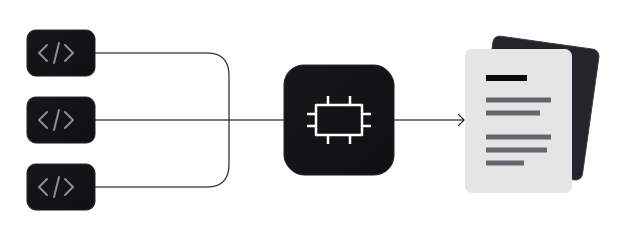
HarnessAny is being built to host that loop for your product. You send the task and its context; the harness works through the steps and returns files your application can use.
Explore the workflowYour choice of harness.
One way to connect.
Build around your task, not a different integration for every agent. The planned lineup brings Codex, Claude Code, and Pi behind the same task and artifact contract.
- Planned

Codex
- Planned

Claude Code
- Planned

Pi
HarnessAny will maintain the supported lineup and its integrations.
The task goes in.
The work comes back.
A consistent path from the request in your application to the files your users need.
- 01
Send the task.
Choose a maintained harness and describe the work. Include the context it needs and the files you want back.
- 02
Follow the execution.
Receive normalized events as the harness works. Keep your application informed without interpreting a different log format each time.
- 03
Receive the artifacts.
Bring the finished files and final task state back into your product. The result has somewhere to go.
{
  "harness": "pi",
  "model_access": {
    "mode": "platform"
  },
  "task": "Clean orders.csv and summarize sales.",
  "artifacts": [
    "cleaned-orders.csv",
    "report.md"
  ]
}
Illustrative contract · not a callable endpoint
Your model access.
Your choice.
Bring your own key.
Connect your own model API key. Keep your model relationship while HarnessAny handles the harness execution.
BYOK · Planned
Use platform models.
Start without configuring a model key. The planned platform option combines model access and harness execution.
Platform access · Planned
A few things before you build.
When can I start using HarnessAny?
The waitlist is open. Invitations will be sent in waves as access becomes available. The task API and model access options shown here are still in development; joining the list does not provide immediate API access.
How is an agent harness different from a model API?
A model API gives your application access to a model: you send input and receive a response, which may include a request to call a tool. An agent harness manages the work around those calls. It supplies context, runs tools, reads their results, and continues through the task. For a CSV cleanup, that means reading the file, running a cleanup script, checking the output, and writing the result. The model is one part of that process; the harness connects the steps.
What would HarnessAny manage for my product?
HarnessAny is being built as a hosted agent harness service. It would run a maintained harness and expose its work through a common task API, execution events, and file outputs. Your team would still define the task, provide the relevant context, and decide how users review or use the result. The aim is to reduce the integration and maintenance work involved in running supported harnesses yourself. Custom CLI uploads and general-purpose runtime hosting are outside the scope.
Which agent harnesses are planned?
Codex, Claude Code, and Pi are the planned initial lineup. HarnessAny maintains the supported set; custom CLI uploads and general-purpose runtime hosting are outside the product scope.
What comes back from a task?
The task contract is designed to return execution events, a final status, and generated files called artifacts. Your application can use the events to show progress and present the files for review or download. In the illustrative CSV task, the outputs are cleaned-orders.csv and report.md, so the user can inspect both the data and an explanation of the changes.
Can I use my own model API key?
Both options are on the roadmap. BYOK lets you connect your own model API key to the hosted agent harness. Platform model access is intended for teams that prefer to start without configuring a separate model key. Availability and setup details will be included with your invitation.
What does early access cost?
Pricing is not published yet. Joining the waitlist requires no card or commitment. Your invite will explain the access available to you.
What happens after I join the waitlist?
We send a confirmation email when your address is added. You will receive an invite when a place is available in your wave.
What will your first task be?
Have a workflow that needs finished files? Join the HarnessAny waitlist to explore a hosted agent harness for your product.